

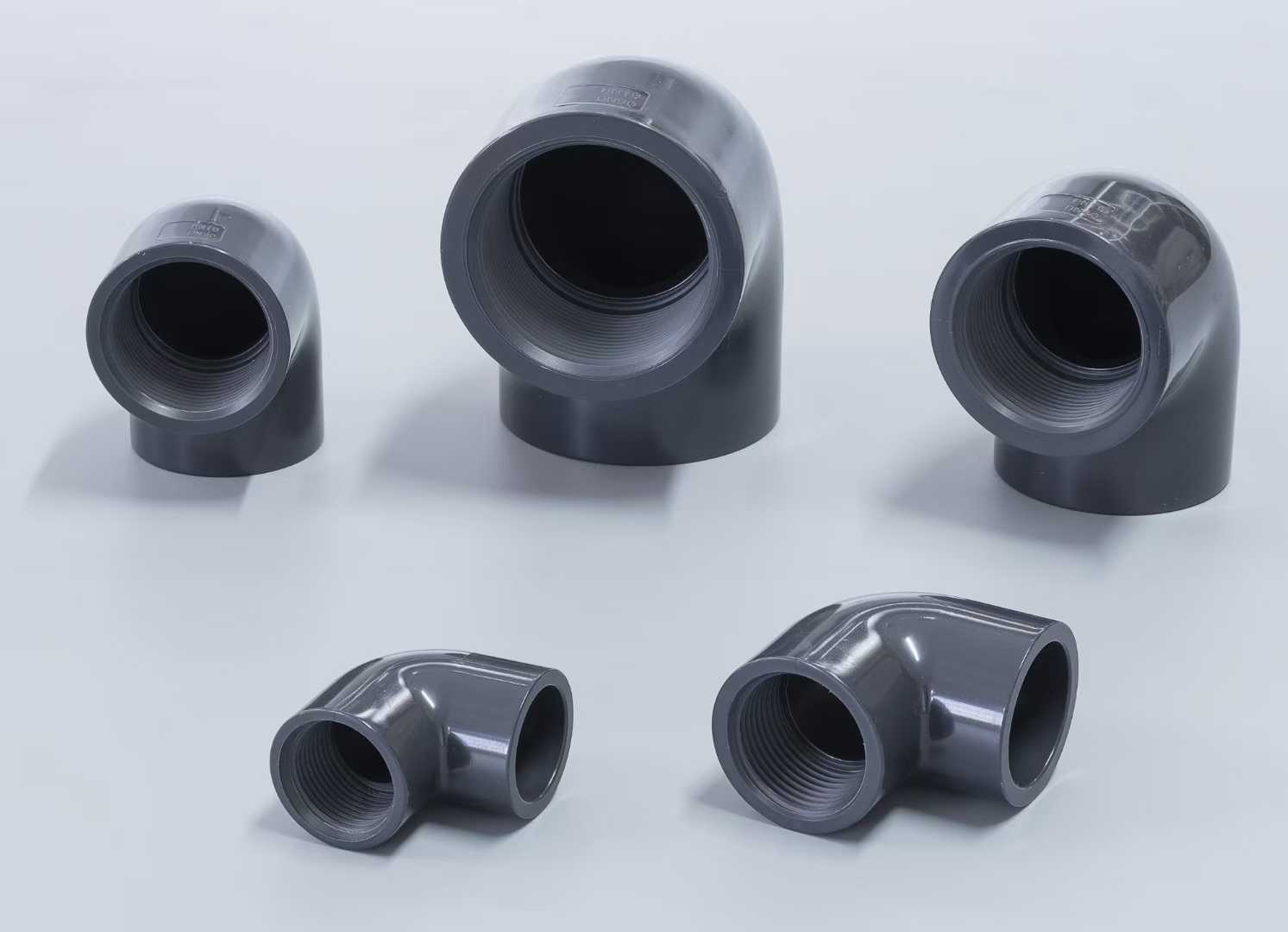
PVC 90-degree elbows are pipe fittings injection-molded from polyvinyl chloride (PVC), whose core function is to change the direction of PVC pipes by 90 degrees. Lightweight, corrosion-resistant, and easy to install, they are widely used in various fields such as building water supply and drainage, municipal engineering, chemical industry, and agricultural irrigation. As an indispensable component of PVC pipe systems, they are gradually replacing traditional metal elbows and becoming the preferred choice for low-pressure pipe systems. They are often used in conjunction with other PVC fittings and PVC valves to form a complete, stable pipe connection system. Below is a brief overview of their key features and applications.
I. Main Types of PVC 90-Degree Elbows
PVC 90-degree elbows are mainly categorized by their connection methods and intended uses, designed to fit different application scenarios and match PVC pipes of various specifications:
1. Classified by Connection Method
- Cemented Type: The most commonly used type, featuring sockets at both ends that require bonding to PVC pipes with special PVC adhesive. It offers excellent sealing performance and is suitable for low-pressure systems such as water supply and drainage, with specifications ranging from DN15 to DN315. It is frequently used with PVC pipes and small PVC valves in residential settings.
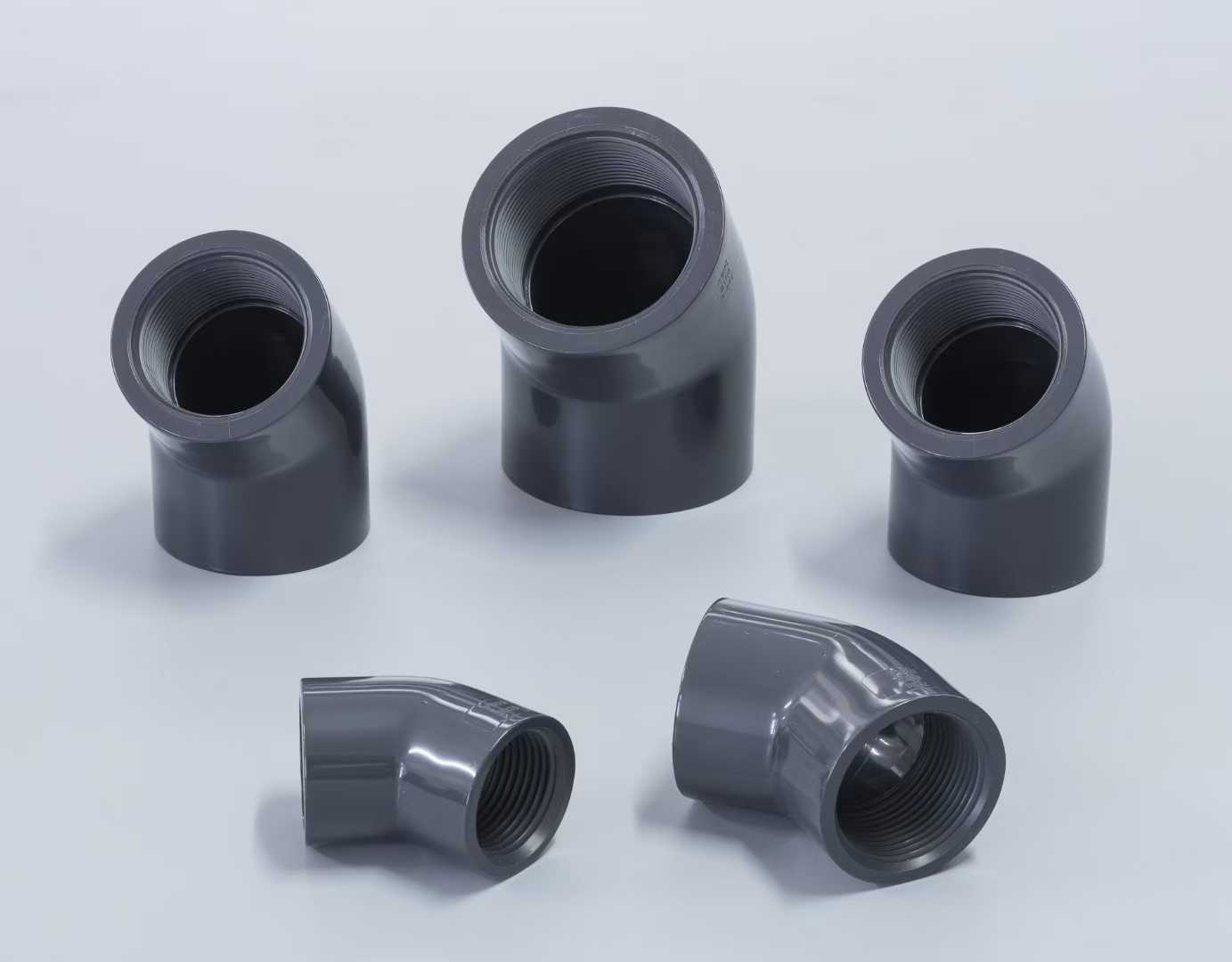
- Threaded Type: One end is a socket (for bonding to PVC pipes), and the other is a threaded interface—no adhesive is needed, making installation hassle-free. It is ideal for scenarios requiring frequent disassembly and maintenance (e.g., household water purifier connections) and can be directly connected to threaded PVC valves or other PVC fittings.
- Flanged Type: Equipped with flanges at both ends, it is secured with bolts for firm, reliable sealing. Suitable for high-pressure, large-flow industrial and municipal pipelines, it typically comes in specifications of DN100 and above and is often paired with large-diameter PVC pipes and industrial-grade PVC valves.
-
2. Classified by Use
- For Water Supply and Drainage: Made of non-toxic UPVC material that meets drinking water standards, it is used to change the direction of PVC pipes in civil buildings and municipal water supply and drainage systems, and can be perfectly matched with water supply and drainage PVC fittings and PVC valves.
- For Chemical Industry: Constructed from CPVC material with enhanced corrosion resistance, it can withstand a variety of chemical media. It is suitable for reagent transportation in chemical plants and laboratories, often used alongside corrosion-resistant PVC pipes and PVC valves.
- For Agriculture: Anti-aging and durable, it is adapted for outdoor use, used to change the direction of PVC pipes in farmland and greenhouse irrigation. Cost-effective and easy to connect with agricultural PVC pipes and simple PVC fittings.
II. Core Uses of PVC 90-Degree Elbows
The primary function of PVC 90-degree elbows is to alter the flow direction of PVC pipes. When combined with PVC fittings and PVC valves, they find wide application in various fields:
- Civil Buildings: Primarily used to change the direction of PVC pipes in water supply and drainage systems of residences, office buildings, etc. (e.g., pipeline layout in toilets and kitchens), ensuring water safety. It is usually paired with household PVC fittings and PVC valves.
- Municipal Engineering: Used in municipal drainage, rainwater collection, and sewage treatment PVC pipes. It adapts well to humid underground environments, extending the service life of the pipe system, and coordinates seamlessly with municipal-grade PVC fittings and PVC valves.
- Industrial Field: Suitable for pipelines requiring low pressure and high corrosion resistance (e.g., chemical reagent and electronic pure water transportation), preventing medium contamination and leakage. It is used with professional industrial PVC pipes, PVC fittings, and PVC valves.
- Agricultural Field: Used to change the direction of PVC pipes in farmland and orchard irrigation. Easy to install and cost-effective, it is suitable for long-term outdoor use and matches well with agricultural PVC pipes and simple PVC fittings.
- Other Fields: It can also be used for corner connections of ventilation PVC pipes and cable protection PVC pipes, flexibly adapting to different installation scenarios and connecting with corresponding PVC fittings.
III. Correct Installation and Usage Methods of PVC 90-Degree Elbows
Taking the most commonly used cemented type as an example, the following are the core installation steps and precautions to ensure sealing performance and service life—these also apply to the matching installation of PVC pipes and related PVC fittings:
1. Preparations
- Select elbows suitable for the pipe specifications and application scenario (e.g., UPVC for water supply and drainage), and ensure they are compatible with the connected PVC pipes, PVC fittings, and PVC valves.
- Clean the insertion end of the PVC pipes and the socket of the elbows, removing dust, oil stains, and burrs. Keep the surfaces dry to ensure a strong bond with PVC fittings.
- Prepare tools and materials such as special PVC adhesive, sandpaper, and a pipe cutter—these are also necessary for installing other PVC fittings and connecting PVC valves.
2. Installation Steps
- Cut the PVC pipe and polish the cut to ensure it is flat and free of burrs, avoiding damage to the bonding surfaces of the elbows and PVC fittings.
- Evenly apply special PVC adhesive to the outer surface of the PVC pipe’s insertion end and the inner wall of the elbow’s socket.
- Quickly insert the PVC pipe into the socket up to the marked line, and gently rotate it 1-2 times to ensure uniform adhesion—this is the same bonding method used for most PVC fittings.
- Wipe off any excess adhesive and allow it to cure in a well-ventilated, dry environment (approximately 24 hours at 25℃). Do not move the pipes or allow water to pass through during curing, as this may affect the connection between the elbows, PVC pipes, and PVC fittings.
- After curing, conduct a water pressure test (0.6-0.8MPa, held for 30 minutes). If no leakage is detected, it can be put into use. It is also necessary to check the connection tightness of the matching PVC fittings and PVC valves.
3. Usage Precautions
- The maximum service temperature should not exceed 60℃, and it should not be used for PVC pipes carrying high-temperature fluids—this is a common requirement for most PVC fittings and PVC valves.
- Avoid external impact and extrusion to prevent damage to the elbows, PVC pipes, or matched PVC fittings.
- It is only suitable for low-pressure systems (pressure ≤1.0MPa), not for high-pressure pipelines. For high-pressure scenarios, select special high-pressure PVC pipes, PVC fittings, and PVC valves.
- Inspect regularly after long-term use, and promptly replace elbows, damaged PVC pipes, or faulty PVC fittings and PVC valves if water leakage or cracking is found.
IV. Advantages of PVC 90-Degree Elbows Over Metal Elbows
Compared with traditional metal elbows (such as cast iron and stainless steel), PVC 90-degree elbows—when used together with other PVC pipes and PVC fittings—offer distinct advantages, especially when paired with PVC valves to form a complete system:
1. Superior Corrosion Resistance
PVC is highly resistant to corrosion from acids, alkalis, sewage, and other substances, eliminating issues of rust and leakage. In contrast, metal elbows are prone to rust and corrosion, resulting in high maintenance costs—this corrosion problem also affects matching metal fittings and valves.
2. Light Weight and Easy Installation
PVC weighs only 1/5 to 1/10 of metal, making it easy to transport and handle. Cemented installation requires no professional equipment, and is much more efficient than the welding or thread fastening required for metal elbows. Additionally, the installation of matching PVC pipes, PVC fittings, and PVC valves is simpler.
3. Low Cost and High Cost-Effectiveness
PVC elbows cost only 1/10 to 1/5 of stainless steel elbows and have a service life of up to 50 years, with no need for regular derusting or anti-corrosion treatment. Metal elbows, on the other hand, have high maintenance costs and a shorter service life, and the associated metal fittings and valves further increase the overall cost.
4. Environmental Friendliness and Non-Toxicity
UPVC elbows for water supply and drainage are non-toxic, meet drinking water standards, and are recyclable. Some metal elbows may contaminate water quality, and the recycling cost of metal fittings and valves is high.
5. Smooth Inner Wall and Low Flow Resistance
The inner wall of PVC elbows is smooth and free of burrs, reducing the risk of scaling and blockages and ensuring high transportation efficiency. In contrast, the inner wall of metal elbows is rough, which easily accumulates scale and hinders flow—a problem also present in matching metal fittings and valves.
6. Anti-Aging and Long Service Life
PVC contains anti-aging additives, enabling it to withstand harsh outdoor environments with a service life of 50 years. Metal elbows age and corrode quickly, requiring frequent replacement, as do their matching metal fittings and valves.
