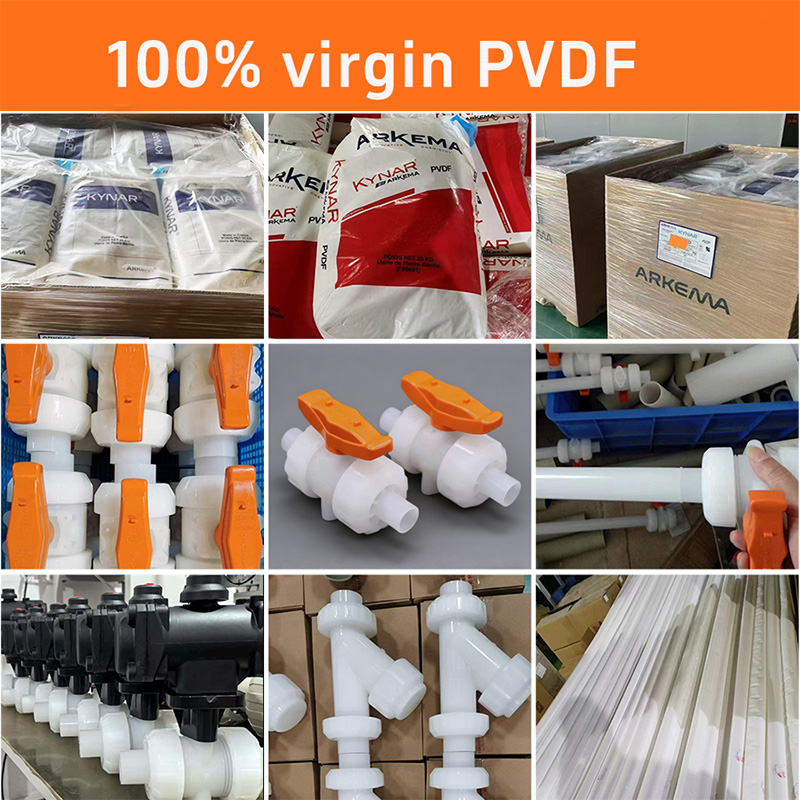
Last updated: May 2026 · Reading time: 12 minutes · Author: Huiya Engineering Team
If you are specifying a valve for hydrofluoric acid distribution, 98% concentrated sulfuric acid service, semiconductor wet processes, or lithium battery electrolyte transfer — you are likely already aware that standard plastic valves (PVC, CPVC, PP) will not survive the chemistry, and metallic valves either corrode or contaminate the process. PVDF diaphragm valves are the engineering benchmark for these severe duties.
This guide consolidates everything you need to specify a PVDF diaphragm valve correctly: material fundamentals, diaphragm selection, pressure-temperature derating, chemical compatibility, actuation options, and real-world deployment data from semiconductor foundries and EU specialty chemical plants. By the end, you will have the technical basis to issue an RFQ with confidence.
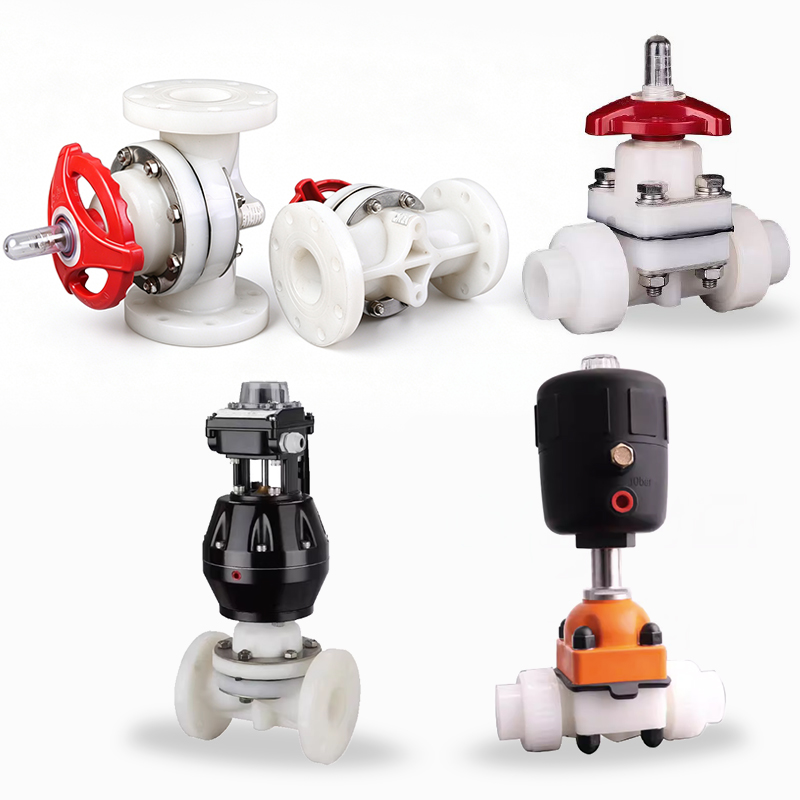
Why PVDF? The Material Behind the Valve
PVDF (Polyvinylidene Fluoride) is a semi-crystalline fluoropolymer with a unique combination of properties that makes it the material of choice for severe industrial service:
- Near-universal chemical inertness — the carbon-fluorine bond resists attack from concentrated mineral acids, oxidizing agents, halogens, and aggressive solvents
- Mechanical strength sufficient for pressure service — unlike PTFE (which requires liner support), PVDF has the rigidity to form pressure-containing components on its own
- Temperature window of -20°C to +120°C in continuous service — broader than PP, CPVC, or PVC
- Very low extractable content — critical for semiconductor and pharmaceutical applications where process contamination is unacceptable
- UV and weathering resistance — outdoor service without degradation
For context, here is how PVDF compares to other common plastic and metallic valve materials in severe chemical service:
| Material | HF Resistance | 98% H2SO4 | Max Working Temp | Purity Grade |
|---|---|---|---|---|
| PVDF | Excellent | Excellent | 120°C | Semiconductor |
| PTFE (Lined) | Excellent | Excellent | 200°C | Ultrapure |
| PP / PPH | Limited (≤40%) | Poor | 80°C | Industrial |
| CPVC | Poor | Poor | 90°C | Industrial |
| UPVC | Not Recommended | Not Recommended | 60°C | Industrial |
| Stainless Steel | Not Recommended | Limited | — | Risk of metal contamination |
The takeaway: for hydrofluoric acid, concentrated sulfuric acid, semiconductor chemistry, and any application where you cannot afford process contamination, PVDF is the working benchmark. PTFE-lined valves outperform PVDF in temperature range, but at 3-5x the cost — a premium that is rarely justified outside ultra-high-temperature service above 120°C.
Why a Diaphragm Valve (and not a Ball Valve)?
For severe chemical service, the diaphragm valve architecture has structural advantages that ball, butterfly, and gate valves cannot match:
- Zero stem-to-process contact. The diaphragm physically isolates the valve stem from the process fluid. Stem corrosion, stem leakage, and packing failure — all top failure modes in ball and gate valves — simply do not occur.
- Bubble-tight closure over particles and slurries. The flexible diaphragm seals against a smooth weir, closing over suspended solids, crystallizing media, and fiber-laden streams without becoming damaged.
- No dead legs. The flow path is smooth and obstruction-free, eliminating crevices where contaminants can accumulate. Critical for high-purity service.
- Field-replaceable diaphragm. When the diaphragm reaches end of service life, it can be replaced in-place without removing the valve from the piping system.
For applications where a ball valve makes more economic sense — non-aggressive media, isolation duty without slurries — refer to our PVDF Ball Valve product range. For applications requiring throttling and shutoff in severe chemistry, the diaphragm valve is almost always the better engineering choice.
Application 1: PVDF Diaphragm Valve for Hydrofluoric Acid (HF)
Hydrofluoric acid is among the most aggressive industrial chemistries. It attacks glass, dissolves silicates, and corrodes nearly all metallic materials. Standard plastic valves fail rapidly — even PP and CPVC degrade within months of HF service.
PVDF, by contrast, has been the industry-standard material for HF distribution in semiconductor wafer fabs for over 20 years. With a PTFE-faced EPDM compound diaphragm, the valve handles HF acid up to 49% concentration in continuous service:
| HF Concentration | 20°C | 60°C | 90°C |
|---|---|---|---|
| Up to 10% | Recommended | Recommended | Recommended |
| 10% – 25% | Recommended | Recommended | Limited |
| 25% – 49% | Recommended | Recommended | Limited |
Real-world deployment: A Tier-1 semiconductor foundry in Taiwan installed 280 pieces of DN15-DN50 Huiya PVDF flanged diaphragm valves with pneumatic actuators for HF acid distribution in a 12-inch wafer fab in Q3 2023. After 28 months of continuous service, the system has logged zero failures and consistently meets the fab's stringent validation for particle count and TOC leach-out.
Typical HF applications served by PVDF diaphragm valves:
- Semiconductor wet etching (oxide removal, surface cleaning)
- Stainless steel pickling lines (HNO3/HF mixed acid)
- Glass etching and frosting
- Fluorochemical production feedstock distribution
- Solar cell texturing and cleaning
Application 2: PVDF Diaphragm Valve for Concentrated Sulfuric Acid (98% H2SO4)
Concentrated sulfuric acid is both highly corrosive and strongly oxidizing — a combination that destroys PP, CPVC, and PVC and creates passivation issues in stainless steel. PVDF resists 98% H2SO4 up to approximately 60-80°C in continuous service, depending on diaphragm selection:
| H2SO4 Concentration | 20°C | 60°C | 90°C |
|---|---|---|---|
| ≤50% | Recommended | Recommended | Recommended |
| 50% – 80% | Recommended | Recommended | Limited |
| 80% – 98% | Recommended | Recommended | Limited |
Real-world deployment: A global specialty chemical manufacturer at a German facility installed 115 pieces of DN80-DN100 Huiya PVDF diaphragm valves with butt-fusion ends and heavy-duty manual handwheels in Q2 2023 for a 98% sulfuric acid bulk-storage manifold operating up to 50°C. After 30 months of operation, the system has experienced zero reports of material permeation, structural compromise, or seal leakage.
Application 3: PVDF Diaphragm Valve for Semiconductor Wet Process
Semiconductor manufacturing imposes the strictest material requirements of any industry served by PVDF valves. In a wafer fab, valves contact ultrapure water (UPW), high-purity chemicals (HF, BHF, SC1, SC2), and slurries — and must do so without contributing particles, metal ions, or organic leach-out (TOC).
PVDF, combined with PTFE-faced diaphragm and clean-room packaging, is the standard material for semiconductor wet process valving:
- Wet etch tools — HF, BHF (buffered oxide etch), and SC1/SC2 cleaning chemistry distribution
- Ultrapure water (UPW) loops — distribution from polishers to point-of-use
- CMP (Chemical-Mechanical Polishing) — slurry distribution, post-CMP rinse
- Wet stations and benches — automated chemical dispensing
- Photoresist strip lines — Piranha-resistant configurations available
For semiconductor service, specify PVDF body with PTFE-faced EPDM diaphragm and pneumatic actuation (single-acting normally closed) for automated tool integration. Cv values, dimensional drawings, and 3.1 material traceability certificates are available on request.
Application 4: PVDF Diaphragm Valve for Lithium Battery Electrolyte
The lithium battery industry is in a global expansion cycle through 2026, with new gigafactories under construction across China, Europe, and North America. Battery electrolyte production — specifically the handling of LiPF6 dissolved in carbonate solvents (EC, DMC, EMC, PC) — has stringent material requirements:
- Zero moisture ingress (LiPF6 hydrolyzes on contact with water)
- Zero metal contamination (catalytic decomposition of electrolyte)
- Compatibility with aggressive fluoride byproducts
- Bubble-tight shutoff for batch dosing accuracy
PVDF meets all four requirements. In fact, PVDF is itself used as the battery binder material in many cathode formulations — its compatibility with battery chemistry is intrinsic, not merely tolerated.
For battery electrolyte service, the typical specification is: PVDF body, PTFE-faced EPDM diaphragm, pneumatic double-acting actuation for high-cycle dosing duty, and butt-fusion or flanged ends for clean-room piping integration. Browse our complete PVDF diaphragm valve range for battery-grade configurations.
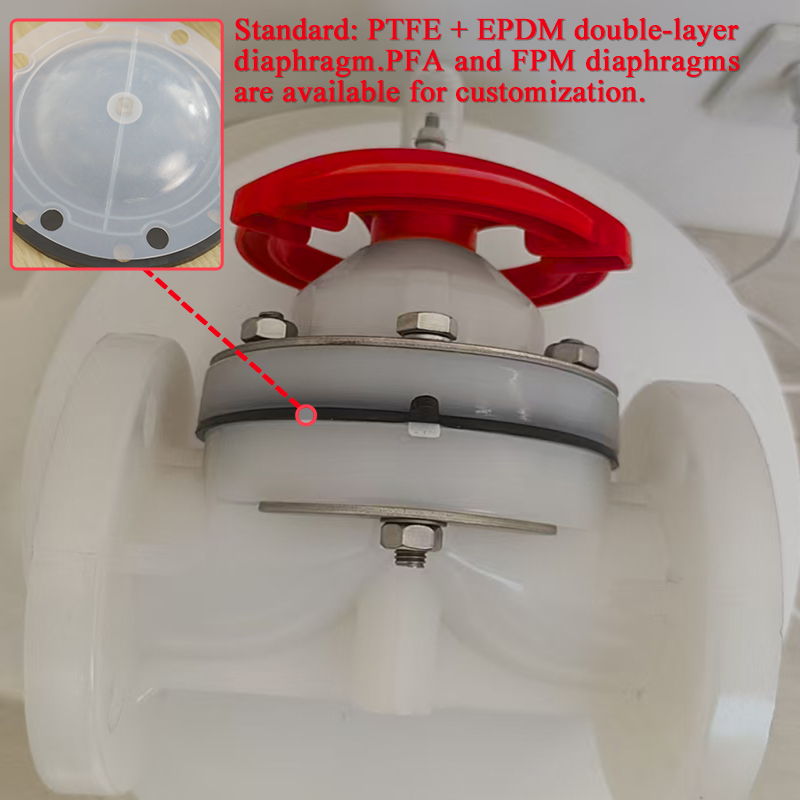
Diaphragm Material Selection — The Heart of the Valve
Body material handles the structural duty. The diaphragm is what actually meets the chemistry. Choose the right diaphragm and you get years of service life; choose wrong and you have weeks. Four constructions cover virtually all industrial chemistry:
| Diaphragm | Best For | Temperature Range | Avoid In |
|---|---|---|---|
| EPDM | General water, dilute acids and bases, cooling loops | -20°C to 100°C | Oils, fuels, concentrated oxidizers |
| PTFE-Faced EPDM (standard) | Concentrated mineral acids (HF, H2SO4, HCl, HNO3), oxidizers, semiconductor service | -20°C to 120°C | — |
| FEP/F46-Faced EPDM | Strong chemicals at slightly lower cost than PTFE | -20°C to 100°C | Extreme cyclic duty |
| FKM (Viton) | Fuels, oils, aromatic solvents, elevated-temperature hydrocarbons | -10°C to 150°C | Ketones, esters, hot caustic, amines |
Engineering tip: Huiya's reinforced PTFE/EPDM compound diaphragm has demonstrated approximately 3x the service life of standard EPDM in side-by-side customer testing across HF and concentrated sulfuric acid duty. For severe-service applications, the marginal cost premium of the PTFE-faced diaphragm pays back within months in reduced maintenance and downtime.
Pressure–Temperature Derating
One of the most common engineering oversights when specifying PVDF diaphragm valves is failing to account for pressure derating at elevated temperature. PVDF, like all thermoplastics, loses mechanical strength as temperature rises — and maximum allowable working pressure decreases accordingly.
The table below shows the service factor (multiply by nameplate PN rating) for PVDF body construction across operating temperature:
| Size | 20°C | 60°C | 90°C | 120°C |
|---|---|---|---|---|
| DN15 - DN50 | 1.0 | 1.0 | 0.6 | 0.4 |
| DN65 - DN100 | 1.0 | 0.8 - 1.0 | 0.5 | 0.3 |
| DN125 - DN150 | 0.6 | 0.6 | 0.4 | 0.2 |
| DN200 | 0.4 | 0.4 | 0.2 | 0.1 |
For example: a DN50 PVDF diaphragm valve rated at PN10 (10 bar) at 20°C is rated at 4 bar at 120°C. Failing to account for this in process design is a leading cause of valve failure in heated chemical service.
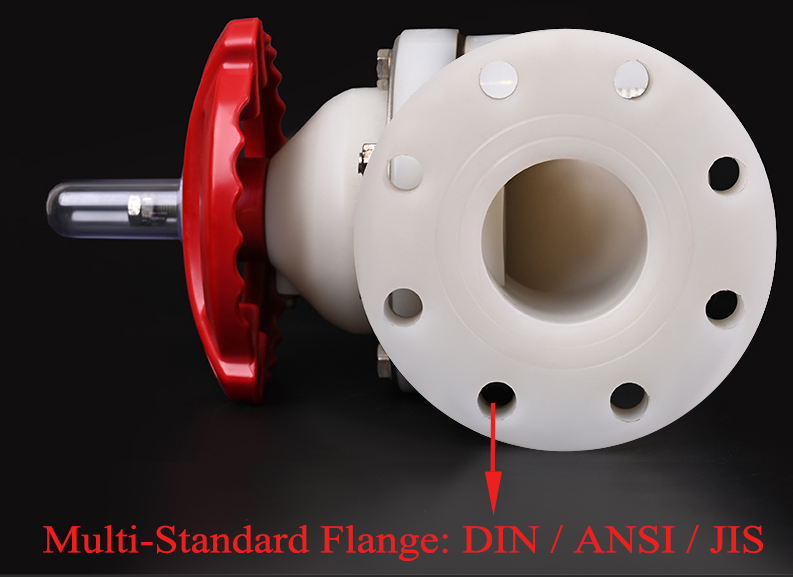
Actuation Selection: Manual, Pneumatic Single-Acting, or Double-Acting?
The same PVDF body platform supports three actuation options — choose by your control philosophy, not by your valve specification.
Manual Handwheel
Multi-turn rising-stem handwheel with self-locking thread and visual position indicator. No air or power required. Best for isolation duty, batch service, and lines where field-replaceable diaphragm service is required without disturbing the actuator. Available DN15 to DN200.
Pneumatic Single-Acting (Spring Return)
Fail-safe close (normally closed) or fail-safe open (normally open) configuration. The actuator uses pneumatic pressure to drive against a return spring, and reverts to its fail-safe state on loss of air. Standard for emergency-shutoff service, batch chemical lines, and any process that must default to a safe state on instrument air failure.
Pneumatic Double-Acting
Higher torque output for large diameters (DN100+) and continuous high-cycle automation duty. Pneumatic pressure drives both opening and closing — no return spring. Used in semiconductor wet stations, fab-wide control loops, and process applications requiring fast actuator response.
All pneumatic configurations accept the full range of accessories: solenoid valves (3/2 or 5/2), limit switch boxes (inductive or mechanical), E/P positioners (4-20 mA), filter regulators, and manual override units. For pre-configured automated assemblies, see our pneumatic valve product range.
Chemical Compatibility Quick Reference
The table below summarizes recommended service for PVDF body with PTFE-faced diaphragm across common industrial chemistries:
| Chemical | Concentration | 20°C | 60°C | 90°C |
|---|---|---|---|---|
| Hydrofluoric Acid (HF) | up to 49% | Recommended | Recommended | Limited |
| Sulfuric Acid (H2SO4) | 98% | Recommended | Recommended | Limited |
| Hydrochloric Acid (HCl) | up to 37% | Recommended | Recommended | Recommended |
| Nitric Acid (HNO3) | up to 70% | Recommended | Limited | Not Recommended |
| Sodium Hydroxide (NaOH) | up to 50% | Recommended | Limited | Not Recommended |
| Sodium Hypochlorite (NaClO) | up to 15% | Recommended | Recommended | Limited |
| Hydrogen Peroxide (H2O2) | up to 50% | Recommended | Recommended | Limited |
| LiPF6 Battery Electrolyte | battery grade | Recommended | Recommended | — |
| Ultrapure Water (UPW) | >18 MΩ·cm | Recommended | Recommended | Recommended |
| Chlorine (Cl2, dry) | industrial | Recommended | Limited | Not Recommended |
Note: indicative data only. Concentration, temperature, and trace contaminants affect actual performance. Request a project-specific compatibility review before specifying for critical service.
Specifying a PVDF Diaphragm Valve — Engineering Checklist
When issuing an RFQ for PVDF diaphragm valves, include the following information to receive an accurate quote and avoid downstream specification rework:
- Size and quantity — nominal DN or inch size, total quantity
- Process medium — chemical name, concentration, presence of suspended solids or fiber
- Operating conditions — temperature (continuous and peak), pressure (continuous and peak)
- Actuation — manual, pneumatic single-acting (NC or NO), pneumatic double-acting, or electric
- End connection — flange standard (ANSI B16.5 / DIN PN10-PN16 / JIS 10K), socket fusion, or true union
- Accessories required — solenoid, positioner, limit switch box, filter regulator
- Certification requirements — material traceability (3.1 MTC), pressure test certificates, compliance standards
- Special requirements — cleanroom packaging, specific color, OEM private label, lead time constraints
Senior engineers at Huiya will return a complete technical package within 24 hours, including dimensional drawings, data sheets, Cv flow data, and a firm quote.
Conclusion: When to Specify PVDF Diaphragm Valves
PVDF diaphragm valves are the right specification when your application has at least one of the following characteristics:
- Concentrated mineral acids (HF, 98% H2SO4, HCl, HNO3)
- Oxidizing agents and halogens (Cl2, Br2, hypochlorite)
- Semiconductor wet chemistry or ultrapure water service
- Lithium battery electrolyte handling
- Slurry, fiber-laden, or crystallizing media that defeats ball or gate valves
- Process integrity requirements that cannot tolerate metal-ion contamination
- Continuous service temperature 60°C or above with chemistry above PP/CPVC limits
For applications outside these conditions, simpler valve technologies (PVC ball valves, CPVC butterfly valves, PP check valves) may be more cost-effective. Browse our complete diaphragm valve product family across PVC, CPVC, PPH, and PVDF body materials to match valve specification to application requirements.
Get a Quote for Your Project
Huiya manufactures industrial PVDF diaphragm valves in DN15 to DN200, with manual, pneumatic single-acting, and pneumatic double-acting configurations. Every valve is 100% pressure-tested per API 598 and ISO 5208 before shipment. ISO 9001, ISO 14001, and IATF 16949 certified manufacturer since 2009.
Send your project specifications and receive a complete technical package within 24 hours:
Email: hyapipe@163.com
WhatsApp: +86 134 8631 0973
Product page: www.hyapipes.com/pvdf-diaphragm-valve/
Free samples are available (freight collect). MOQ is 10 pieces. Worldwide shipping from Ningbo or Shanghai. T/T, L/C, Western Union, and PayPal accepted.
Related Articles & Products
- PVDF Diaphragm Valve Product Range — full specifications, dimensional tables, and Cv data
- PVDF Ball Valve — for isolation duty in non-slurry service
- PVDF Butterfly Valve — for large-diameter applications
- PVDF Pipe & Fittings — to complete a full PVDF piping system
- Diaphragm Valve Overview — PVC, CPVC, PPH, and PVDF options compared